
MO-BASED COMMERCIAL VEHICLES (MCV) COWLEY HALF TON
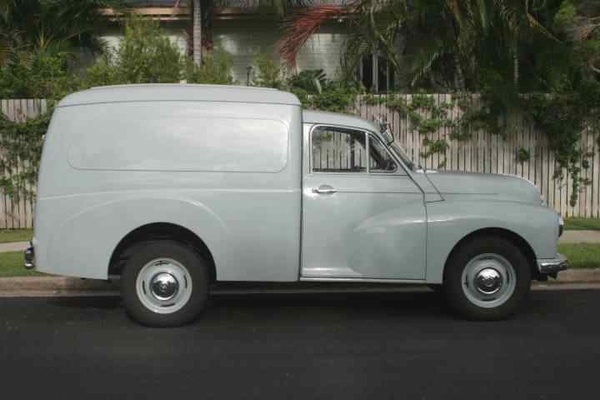
These commercial vehicles were introduced in March 1950 and the front end was based on the Oxford MO and reintroduced the “Cowley” name after a lapse of 15 years. It used the same 1476cc side valve Oxford engine with column change, but with more utilitarian trim inside the cab. It was available as a van, pick up or basic chassis. 43,633 were produced until September 1956 when it was replaced by the MCV SIII half ton.
During the latter part of 1948, to early 1949, when the ‘J -Type’ van of similar capacity was going into production, development work on MO saloon based vans and pick-up trucks (utes) of half ton capacity was initiated. On 16th March 1950, almost two years after the introduction of the saloon, the first ‘production commercial van was dispatched from the Cowley factory (Chassis N° MCV501) followed 16 days later by the first truck, and later that same week, the first chassis-cab.
It is understood that Lord Nuffield (William Morris) had requested that the new vehicle be readily identifiable with the new (and contemporary styled) Morris Oxford MO. The choice of body style made it clear that in the main, much of the rigidity of the ‘Monocoque’ – unitary construction – saloon would be lost, thus MCV (Morris Commercial Vehicles) are based on a true chassis design. This consists of a heavy mild steel frame developed by the Projectile Engineering Company (PECO) Pressings of the Midlands, whilst the body was dealt with by Nuffield Metal Products, both liaising closely with the Morris Commercial Cars design team.
Box-section members run either side of the engine bay and are extended farther back, so, instead of ending at the torsion bar cross-member, mid-way under the car (as with the ‘U’ section rails of the saloon – Wolseley 6/80, 4/50 & Morris Six, which all shared the same features), they continue to the rear of the vehicle, curving outwards to accept the rear spring shackles. The front shackles are mounted on the outer edges of a sturdy ‘yoke’ cross-member, which is bolted and riveted to the chassis frame rails and has an oval cut-out to clear the propeller shaft.


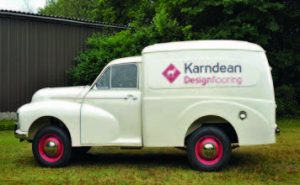
By October 1956, when the Series lll commercials were introduced, approximately 43,600 MCV’s had been built, in three main options. Vans: – 30,100 (69%) Trucks: – 10.600 (25%) Chassis cabs: – 2,600 (6%), there are some 300 unaccounted for which may have been CKD export kits (Completely Knocked Down). The last of the Oxford Series l based MCV’s was N°44100 leaving the assembly line on the 28th September 1956. Like the MO saloons, Chassis N°’s began at N° 501, all lower numbers were factory development vehicles which did not make the showrooms and unless preserved as museum or archive vehicles, are assumed to have been destroyed.
It is testament to the rugged design that MCV’s are still turning up around the world, from Canada to New Zealand and Brazil to Denmark, with several still earning a living as farm trucks – even an ice cream van, more than 65 years after the final one left the factory in 1956. Since the club’s records started, more than 40 years ago, there are 238 surviving vehicles worldwide, which are known to the club.
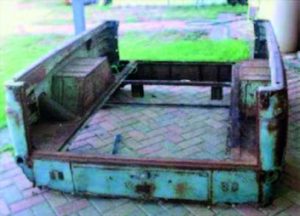
The high survival rate for trucks (Utes) is due to the large numbers exported to Australia with a predominantly drier climate, which has 75%, 37 of these recorded as being in the state of New South Wales. The assembled cab unit was bolted to the chassis and then fitted out similarly to the saloon, with the exception of the torsion bars, which were anchored into even heavier gauge lugs, welded to the side of the chassis rails.
The cab of the MCV utilises most of the MO car panels, i.e. engine bay, floor, inner wings, outer wings, scuttle, forward half of inner floor and sills, front doors and the forward part of the roof panel. The front suspension lower arms were fixed to the lower chassis and the top suspension arm (and shock absorber – Armstrong lever type) was bolted into the cab unit. The same lower body and floor support pressings were used for both van and pick-up which are detachable, as they bolt onto the chassis and the rear of the cab.
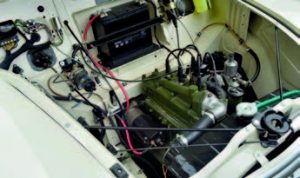
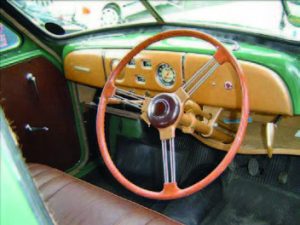
Technical specifications for the MCV are very similar to the saloon and Traveller, all having a four-cylinder side-valve unit of 1476.53cc (90.1 cu. in.) which produced 41bhp @ 4,200 rpm with a compression ratio of 6.5-6.6:1, produced at the Morris Engines Branch in Coventry. The MCV clutch was an 8” Borg & Beck A.6-G dry plate with composite facing, transferring drive to a four speed gearbox, the gear lever was mounted on the steering column. Final drive was by prop-shaft to a semi-floating hypoid axle on semi elliptic leaf springs. Steering was by rack and pinion. The braking system was hydraulic with Lockheed 9” diameter drums. Several rear axle ratios were used, early axles were 9/41 = 4.55:1, later versions 8/39 = 4.875:1 and a low ratio, available on all models and often used on the MCV’s of 8/41 = 5.125:1.
Original text by former chairman Mike Parry, with thanks to Mark Garrett and Steve McNicol.
Additional information Bob Francis MS1304 (magazine editor). Vehicle survival update figures by Club MO Historian Nigel Anderson, MO298.