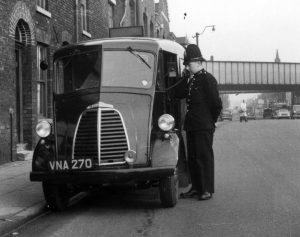
THE MORRIS J-TYPE VAN

Introduced in 1949 this half ton van was known as a Morris Commercial. It had forward controls and sliding cab doors with two rear doors. It was made as a van, pick up or basic chassis and coachbuilders produced many forms. Until 1952 it used the Oxford MO 1476cc side valve engine with a 3speed gearbox. After the formation of BMC in 1952 it was known as the Morris J Type. In 1957 it received the Oxford Series III 1489cc ohv engine and 4 speed gearbox and known as the Morris JB. An Austin version was available from 1957 and known as the Austin 101. 48,600 were made until it was replaced in 1961. Many were used by the British Post Office.
The ‘J’ Type was first shown at the 1948 Commercial Motor show, with the first production models appearing in Autumn 1949. It had a 3- speed gearbox coupled to the side-valve engine common to the MO but used a downdraught carburettor.
Other than a change from split spiral gear to hypoid type axle after approx. 11,276 had been built, the van specification was largely unchanged until 1957.
This is when the BMC ‘B’ Series OHV engine and 4-speed gearbox were adopted and vehicles became known as ‘JB’ vans or for the badge engineered Austin alternative ‘101 vans’.
Production continued until 1961 (Austin and Morris chassis numbers were not separated), with a final total of 48,620. Chassis Numbers started at 001 and the earliest known to the J Type Register is J/R 010, registered to the Oxford Co-Operative Society on 17th September 1949.
The oldest van still known to be mobile, is chassis No. J/R 485, which belongs to the Celtic Old Vehicle Owners Club. The youngest known surviving van is Chassis No. 48582 – only another 38 examples came after it – which was a GPO planner’s van, and is awaiting restoration.
The GPO, with almost one in eight of total production was a prolific user of ‘J’ types, purchasing a total of 6,147.