
THE WOLSELEY 6-80 IN METROPOLITAN POLICE SERVICE
THE WOLSELEY 6-80 IN METROPOLITAN POLICE SERVICE

FURTHER READING
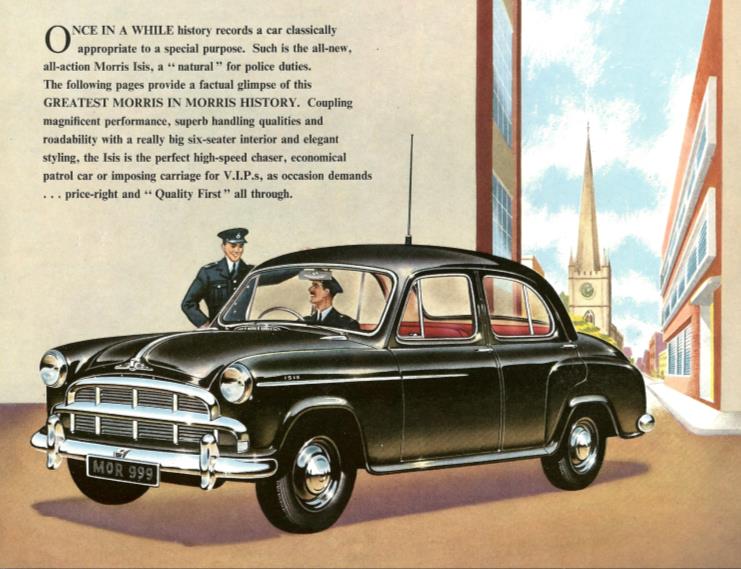
Click here to visit the On Patrol – Calling All Cars page
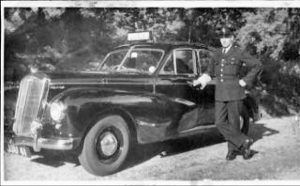
Click here to visit the Memory Lane page
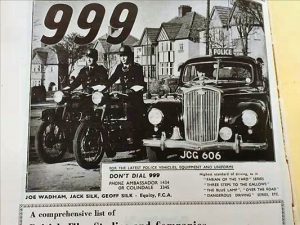
Click here to visit the More Wolseleys in Police Service page
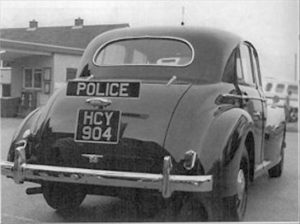
Click here to visit the The Wolseley 6/80 in County Forces Service page
This page covers the use of the Wolseley in Metropolitan Police service, the following page is devoted to its service in County Forces. The Wolseley car has been associated with British Police forces for many decades. Early fleet records from the London metropolitan Police show that one second-hand 16.45hp Wolseley was purchased by the receiver in early 1932 for £40, which was to mark the beginning of a long service record with the police. However, on this web page we are concerned only with one version, the Wolseley 6/80.
The two post-war Wolseley models, the 4/50 and the 6/80, the technical details of which have been fully described on their own respective pages, were used quite extensively in the London area alone. The smaller 4-cylinder 4/50 was used to good effect as a “nondescript” or unmarked saloon for a variety of tasks, often as staff cars, whilst the larger, more powerful and faster 6-cylinder 6/80 eventually became the mainstay of the fleet for Wireless Area Cars and for Motor Traffic Patrol. In this regard, there were distinct visual differences between the vehicles used for these two important functions.
The Wireless Area Car handled the duties associated with the 999 emergency call system, and all other routine patrolling in each district. The enthusiastic onlooker at that time would have seen a plain black 6/80 fitted with an antenna near the rear of the roof, and a chromium plated emergency gong (aka Winkworth bell) in place of the o/s fog lamp, along with a single Lucas wing mirror on the o/s front wing. Other than these three specific external features the car was a fairly normal black 6/80 saloon.
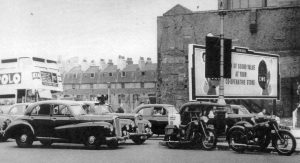
A nondescript 4-50, a 6-80 Traffic Unit & two Triumph 500cc solos, attend a London street incident.
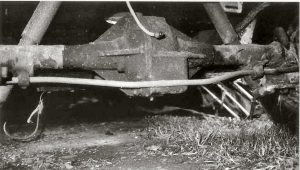
The heavy-duty anti-roll bar fitted only to police specification 6-80s.
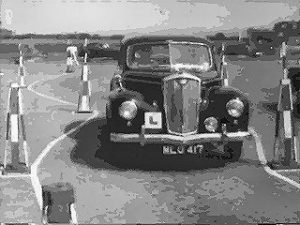
A 4-50 in use at Hendon Motor Driving School during a reversing test.
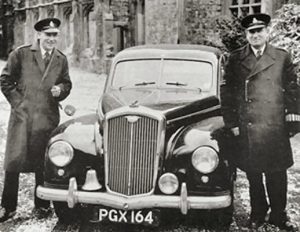
A Wireless Area Car with a two-man crew in the 1950s.
Most police 6/80s were supplied new with an additional heavy-duty anti-roll bar across the rear axle, and not to be confused with the normal anti-roll bar on earlier civilian versions using lever arm shock absorbers (early cars), which were replaced by angled telescopics. In the case of Motor Traffic Patrol, the standard sized tyres; 600×15 cross ply, were replaced by 670x15s, and the torsion bars were ratcheted up a few clicks to give a greater ride height. Although this raised the centre of gravity and altered the weight distribution angle, it made the steering lighter, making the car easier to manoeuvre around fast corners in a street-chase situation.
A larger heavy-duty output dynamo was fitted, and unlike the civilian versions that had the 12v battery under the bonnet, the police versions carried two very large 6v batteries in special compartments under the rear seat. This allowed the radio to be used whilst stationary without the need to keep the engine running to avoid depletion of a single battery. The wiring loom differed considerably from the civilian version, having many additional tributaries to cater for the specialised supplementary electrical equipment. Inside the boot (trunk), mounted on a platform, were the two Pye units of the wireless transmitter and receiver system. There were extra drillings in the base of the rear seat fascia where the loom passed through to the boot and on some examples, brackets just below the rear window – attached to the rear parcel shelf – to support a ‘pop up’ “Stop Police” sign which was operated by a solenoid.
This, and the radio equipment was controlled from a special “in-house-built” tailor made switch panel fitted into the nearside glove locker aperture. A heavy cast metal microphone was carried in its cradle below the dash centre. Motor Traffic Patrol 6/80s carried a specially calibrated speedo unit known as the “A/T head” fitted on to the dash panel in place of the normal speedometer. Both police versions carried an additional interior mirror for the operator who was responsible for logging and dealing with incoming and outgoing wireless messages, map reading, control of the gong in emergencies, and the use of the public address system where applicable. The Wireless Area Car often carried a plainclothes ‘observer’ seated in the rear for occasions when the sight of a uniformed officer might otherwise hinder an ongoing enquiry.
Over the decades a lot has been written about Wolseley police cars, particularly by crime writers of fictional material, elevating the cars’ performance capabilities in print almost to the level of a racing car, often with dramatic references to “souped up” versions as being the norm. The opposite was the case in fact. For a start, in the 1950s the grading of petrol had by no means reached the sophistication of later years, and was known as “pool petrol” during the immediate post-war years. If any “souping up” was done, it was to the drivers rather than their cars, by way of “Roadcraft,” a system of car control invented initially by Sir Malcolm Campbell, and perfected by The Earl of Cottenham in 1934. This system of grading drivers into three specific categories greatly reduced the police accident (polacc) figures dramatically whereby each driver was required at all times:
“(a) to be in the correct place on the road, (b) travelling at the correct speed for the conditions, and (c) with the correct gear engaged.”
No mean feat when you consider that the average driver would find it extremely difficult to maintain these three criteria during every mile driven even by today’s standards. In due course, Hendon Motor Driving School was responsible for spreading this System to other police forces worldwide during the ensuing years. Even to this day, Roadcraft is the mainstay of a safe, defensive driving procedure that enables the police driver to have a distinct advantage over the civilian motorist, because of thorough training instilled at the very early stages of his police-driving career.
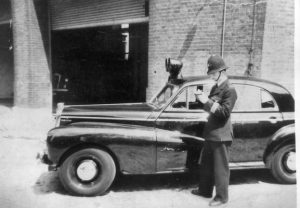
A foot-duty PC checks his notes alongside a Traffic Unit. Note the heavy duty tyres and raised ride height of the 6-80.
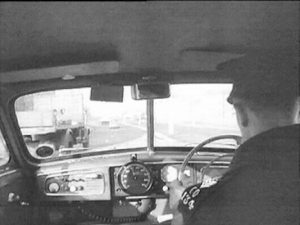
An interior shot of a Traffic Patrol 6-80.
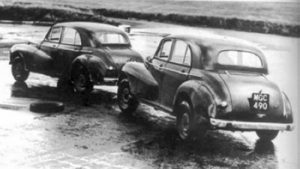
The student and the ‘bandit’ instructor at speed in their 6-80s on the Hendon skidpan.
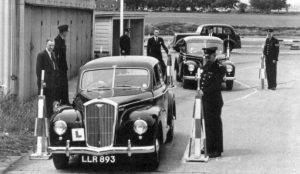
A trainee driver concentrates on a precise reversing manoeuvre at Hendon.
The 6/80’s 2.2-litre overhead camshaft engine (VC22W) was quite efficient in its dealings with everyday policing requirements, and was well able to keep up with the rest of the competition. It had one weakness however, its propensity for devouring its own exhaust valves. This became something of an ongoing irritant to the staff of the MRD (motor repair depot) who had the unenviable task of attempting to rectify a problem that was, in itself, believed to be a manufacturer’s design fault but was in fact merely because the WW1 aero engine upon which the engine’s vale gear (in particular) was based, was intended to run at a constant and lower speed and was not suited to automotive use where high/rapid changes of speed were required, nor working in a hot enclosed environment .i.e. under the bonnet.
There were many suggestions and ongoing engineering debates as to why the valves burned out but it would be fair to say that a combination of the type of vehicle use (vehicles in urban areas that were mostly used for long journeys seemed not to suffer from the problem so much), poor quality low octane fuel (a major cause of detonation/running on and overheating) and the materials the valves and guides were made from at the time, all contributed to the problem. Many ‘Old wives’ tales’ came about, the favourite one being “The valves don’t rotate, hot spots develop and the valves burn out”. Whilst this is partly true and was a contributing factor to the failure of the valve gear, it was not the principle cause. For a clearer understanding of the VC22 engine and it’s history and development, please see “The OHC engines” web page on this site.
In an attempt to address the overheating problem, a revised cylinder head was introduced in 1952, designed by Nuffield’s engine team in conjunction with an Ex Royal navy engineer, Commander Ladbrooke who was employed by the Metropolitan Police. This had a lowered compression ratio, to reduce the propensity of low octane ‘pool’ petrol to detonate, and was taller in design, using longer – and slightly inclined – valves, designed to work at an improved angle.
The lowering of the compression ratio resulted in about a 1bhp power loss per cylinder and to compensate for this the factory lowered the rear axle ratio from 4.1:1 to 4.55:1 (on all models) to compensate for the loss. In any case, many MET city patrol cars were equipped with the “special” ratio axle of 5.125:1 which gave very rapid acceleration. Being able to out-accelerate the bad guys on the streets was deemed far more important than an 80mph + top speed . The redesigned cylinder head also featured a twin impeller water pump and a water transfer rail to improve the distribution of coolant. Although it did reduce the running temperature of the engines, the valve burning problem still persisted although it was reduced.
Apart from both types of 6/80 used by uniformed crews as described earlier, many unmarked 6/80s were also used for a variety of tasks, Flying Squad, “Q” cars, Motor Driving School, Senior Officers transport, and other similar activities where recognition as a police vehicle might not have been desired. As well as these cars, there were a number of 6/80s with (according to Met fleet records) “Morris Six conversion” and used specifically as low profile observation cars. Outwardly, they carried the bonnet and front grille of a Morris MS Six, and were often seen in either Moonstone Grey or similar light colours, but mechanically they were a disguised 6/80.
Unlike most Met vehicles, Wolseley 6/80s enjoyed a longer period of service than either their predecessors or their successors, and it is interesting to note from the records that some of these actual cars were still in service in 1961, when the fleet had already been upgraded by three versions of the later 6/90 and also the first of the Farina-styled Wolseley 6/99.
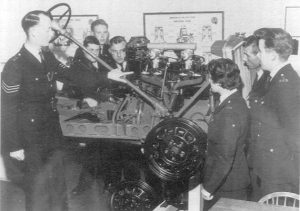
Part of the practical instruction in the Hendon Motor Driving School classroom.
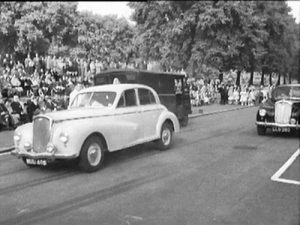
Two unmarked 6/80s and a Morris Commercial PV van take part in a road safety exercise for young children in a 1950s London street.
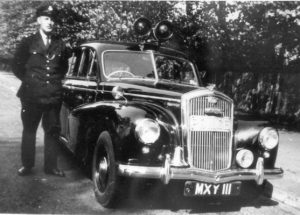
A Motor Traffic Patrol 6/80 with police signs and twin loudhailers.
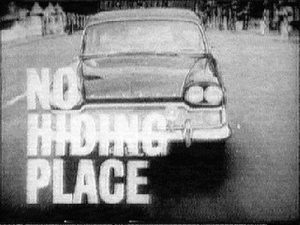
A development of the original police theme for TV was ‘No Hiding Place’ in the 1970s, the car is a Wolseley 6/90.
The 6/80 was truly the ubiquitous police car in many cinema productions of the 1950s, and quite a few feature films were often supported by a short “Scotland Yard” style thriller in which the main theme was one of promoting a pro-police flavour.
It is perhaps this aspect that still attracts onlookers to the model at many classic car shows, for many of the older spectators will remember those black and white films in which either Joe Wadham or Jack Silk appeared in their “police mock-up” 6/80 with a shrilling emergency gong, as equity-approved uniformed stunt drivers for a variety of film production houses, Ealing Studios, Merton Park Studios, and Beaconsfield Studios to name but a few.
At time of writing, it is believed that there are only two surviving ex-Metropolitan Police 6/80s left in Britain, NGH-929 and NXB-181. NGH-929 was a genuine (and provable), patrol car. NXB was a Hendon driving school car, not an active patrol vehicle. Both vehicles were owned by the 6/80 club founder David Barker, who restored NXB, and still owns NGH 929, which is at present undergoing full restoration. Apart from these two specific cars there are also very many police replicas to be seen at various classic car shows.
Motor Traffic Patrol also used the 6/80, and again, each District had at least one of these operating right round the clock. The Traffic Patrol version differed from the Area Car by having additional external equipment, most noticeable of which were the two bowl-shaped loudhailers above the windscreen, and two illuminated number-plate-style police signs across the front and rear with white letters on a Bermuda blue background.
These two versions of the 6/80 therefore, formed the mainstay of the fleet, although they were supplemented by a variety of other similarly sized British makes throughout their service as police vehicles. Apart from the external visual images of both types of police 6/80 in the London area, there were also quite a few mechanical differences compared with a civilian version.
Most photographs in this section are strict Copyright of the London Metropolitan Police Museum and permission has been obtained to display them on this site