
THE MORRIS SIX SERIES MS

The Morris Six Series MS was introduced at the 1948 London Motor Show and was a member of the same family as the Oxford MO and the Minor, using the same body shell as the Wolseley 6/80 and 4/50, which helped standardisation. The MS had a longer bonnet, different front doors (and other features) to the MO but both Oxford and MS had common body finishes, inside and out. It used the 2,215cc ohc six-cylinder engine which was shared with the Wolseley 6/80 but with a single 1½in SU HS4 carburettor instead of the Wolseley’s twin set up.
The Morris Six Series MS was introduced at the 1948 Earls Court Motor Show and was a member of the same family as the Oxford MO and the Minor, using the same body shell as the Wolseley 6/80 and 4/50, which helped standardisation. The MS had a longer bonnet, different front doors (and other features) to the MO but both had common body finishes, inside and out.
Both were built by the Nuffield group at Cowley and it is known that the MS6 was produced because Lord Nuffield (William Morris) wanted a new six-cylinder car to join the Morris Minor and Oxford range at the show.
Only two Morris Sixes were actually built in late 1948 and production didn’t really start until the first quarter of 1949.
Early body colours for the MS were maroon, romain green, black and platinum grey, which were also used by the Oxford and Minor. Some changes were made to the MS during its production lifespan up to early 1954 including modifications to the 2,214.8cc (135.15cu in) ohc six-cylinder engine which was shared with the Wolseley 6/80 but with a single 1 ½” SU HS4 carburettor as opposed to the Wolseley’s twin 1 ¼” HS2 set up. The engine (designated family N° VC22M) produced 70bhp@4,600rpm and like those of the 6/80, 4/50 and Oxford MO was produced at the Morris Engines Branch in Coventry.
Earlier engines were designated Series I but in 1952 a redesigned cylinder head with enlarged waterways and longer inclined valves, designed to work at an improved angle, was introduced. This became known as the Series II commencing from engine N° 20,301.
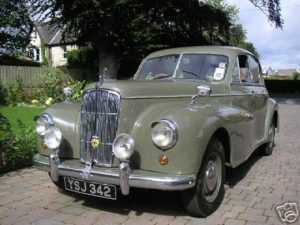
1950 Series 1 MS6, spot & fog lamps were not standard
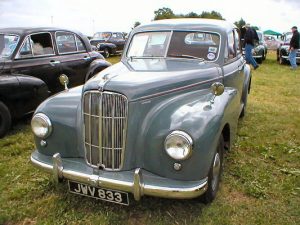
Series 2 car, note bonnet scripts

The VC22M engine
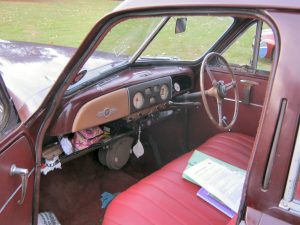
1950 Series 1 interior
It is unfortunate that the engine was not further developed to cure the problem of burning the exhaust valves after a relatively low mileage but the merger in 1952 of The Nuffield Organisation with Austin, to become BMC, meant that the ohv ‘A’ ‘B’ and ‘C’ series engines became available and plans for the “V” family engines were shelved. Any engines that may have suffered with valve problems will have been rectified by now but in any case, the club has commissioned the remanufacture of high quality stainless steel valves, both inlet and exhaust, and hard wearing phosphor bronze exhaust and cast iron inlet valve guides. The Club has never had a report of a newly produced part failing. For further information on the engine design, see “The OHC engines” page.
Early interiors had beige leather bench seats with brown piping, later changed to brown, green or red leather, but in a plainer style. Very early cars had no separate side lights at the front and round stop-lights which were later replaced with the Lucas type fittings seen on all the later Morrises and Wolseleys, separate front side lights were also added.
The centre instrument panel on early cars had a dark brown/black crackle finish, the panels on Series II cars were the same gold colour as the glove box covers and had dark grey bezel rings in the instruments and clock.
Series I cars had no bonnet side-scripts, later vehicles had “MORRIS SIX” scripts in chrome plated Mazak – a zinc based alloy.
During 1949, many cars were exported, with the ‘lion’s share’ going to Australia. However, some cancelled orders saw cars distributed to dealers in Great Britain, with garages offering the Morris Six at the same price as the Oxford!
The trunnion and swivel-pin set up of the front suspension was common to many other vehicles of the time – although in the case of the MS6, the Wolseley 6/80 and the smaller 4/50, was probably over-engineered to some extent to cope with the weight of what was in fact, a very heavy engine, towards the front of the car. As with any set up of this design, the key to reducing wear in the internal trunnion and external swivel-pin threads is to ensure they are greased at the prescribed servicing intervals.
Even when this has been carried out satisfactorily, blocked grease nipples and the failure of the grease to find its way around every component can reduce the life expectancy of these items.
An early change was to replace the Armstrong lever arm dampers with twin telescopic units at the front and singles at the rear. It was also found that the “open scuttles” at the base of the firewall in the engine compartment needed to have plates welded in to strengthen them because of cracking of the legs extending from the body mainframe rails and cars had to be recalled to the factory.
All Morris Sixes used Lockheed hydraulic drum brakes, incorporating twin leading shoes on the front wheels and one leading and one trailing shoe on the rear (to give some degree of braking efficiency when reversing).
The 10” drums employed were more than capable of stopping the 25cwt car.
Tyre pressures were stipulated at 32psi for the original 6.00 x 15-inch cross ply tyres.
Steering was by Bishop cam steering box incorporating six (3 pairs) of track/tie rod ends and a transfer box on the passenger side.
Over riders were fitted to the front and rear bumpers as a customer specified option.
The Morris Six actually changed very little during its production life from October 1948 to March 1954 when it was discontinued after a total run of 12,186 units. Approximately 40 survivors are known to the club. It was a stylish Saloon car with a good turn of speed which also saw use by the police as a patrol vehicle, in particular, the Staffordshire constabulary.
There is only one known MS6 police car survivor to date, which was the chief constable of Staffordshire’s staff car.
It is in original condition and owned by a 6/80 & MO Oxford & Cowley Club member.
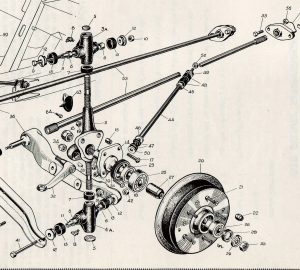
Front suspension

1950 MS6 in maroon
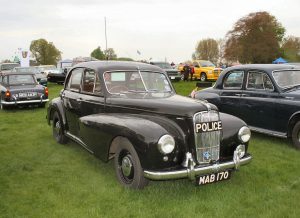
Sole surviving MS6 Police car