
THE OHC ENGINES
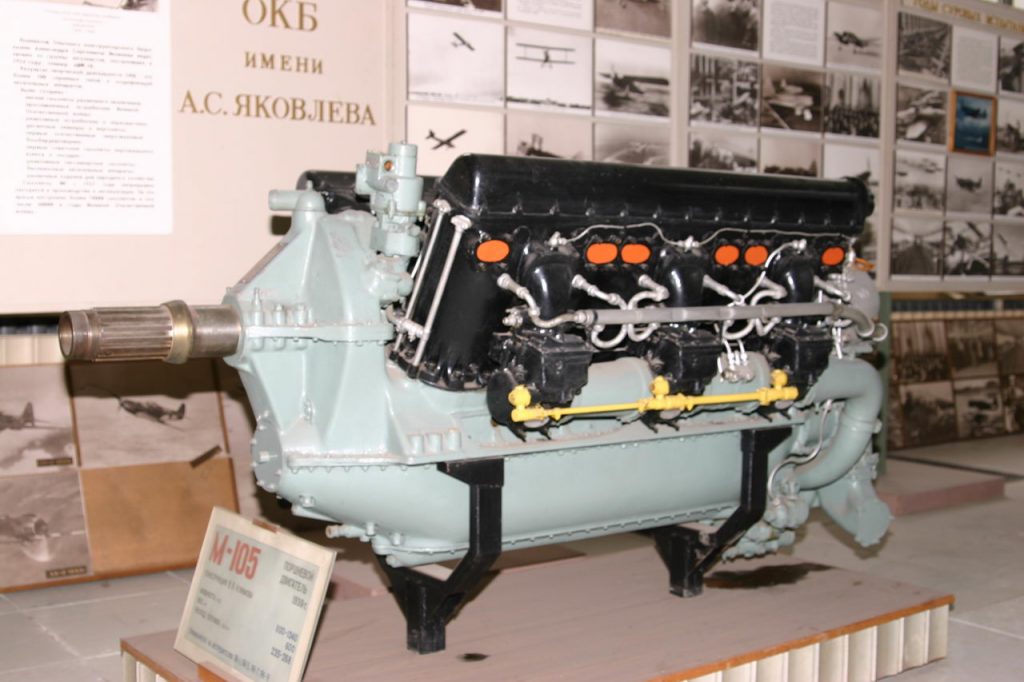
What are the origins of the 6/80, 4/50 and MS6 engines?
“They’re based on an aero engine” is the common reply.
The valve train and some other engine features certainly, but the VC22 engine was developed from a series of concepts and was actually an amalgamation of many different designs.
VC22 was the Nuffield Organisation “engine family” designation for the 6-cylinder ohc Wolseley 6/80 and the Morris Six Series MS engines, both being mechanically identical but designated 22W or 22M according to the model to which they were fitted.
Series ll engines, introduced in 1952, had the label VC22W2 and VC22M2 to denote this.
Dubbed ‘V’, like the ‘A’ ‘B’ ‘C’ series engines of BMC. ‘C’ stood for ohc, ‘22’ was for the 2.2 litre cylinder capacity (actually 2,214.8cc-135.15 cu in) ‘W’ ‘M’ stood for Wolseley and Morris.
The VC22, like its smaller 4-cylinder counterpart the VC15W (Wolseley 4/50 engine) and the Morris Oxford MO side valve (VS15M) engine was produced by the Morris Engines Branch in Coventry.
The 6-cylinder in-line engine featured a single overhead camshaft driven from a vertical shaft at the front of the engine via split helical gears.
The camshaft had a coil spring and friction plate damper at the rear, running in an oil bath, thus was also hydraulically damped, to absorb backlash through the gears which tended to impart a fore and aft oscillation which caused vibration.
The vertical shaft itself was driven from the crankshaft via skew gears, driving the oil pump at the bottom and the distributor at the top.

The Wolseley 6/80 engine
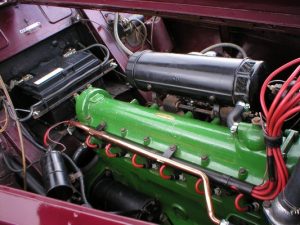
VC22M2 engine in a Wolseley 6-80
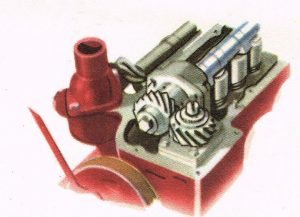
Split helical gear camshaft drive
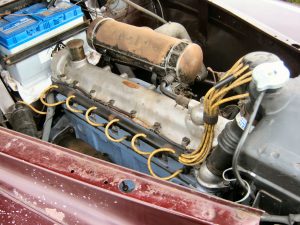
Early Series I engine in an MS6
The cylinder block was cast iron with a detachable 8-port cylinder head utilising a single overhead camshaft in fixed bearing housings thus necessitating removal of the cylinder head and, subsequently, the camshaft in order to work on or remove the valves.
Very early engines had a one-piece camshaft housing cover which meant that the distributor had to be removed in order to adjust the valve clearances. This was soon replaced with a two piece design. Early engines had the oil filler at the rear of the housing.
The power output was 70bhp @4,600rpm in single carburettor (Morris Six specification) form, with 72 bhp for the Wolseley 6/80, which had twin carburettors. The compression ratio was 7:1.
Later Series ll engines with the 10-port cylinder head produced a little less power, about 1bhp per cylinder, due to a reduced compression ratio of 6.5:1. This was to prevent detonation and “running on” caused by the relatively high compression ratio (for the era) combined with poor quality low octane petrol (Pool Petrol) which was all that was available in the post-war period.
The camshaft lobes acted directly onto the tappets which were screwed into the tops of the valve stems, without employing a “tappet carrier”. Adjustment of the valve clearances was by a click-adjust ratchet system.
This idea was carried over from the aero engine upon which many parts of the VC22 were based, i.e. the vertical drive shaft for the cam and valve gear, although the aero engine used bevel gears. Split helical and skew gears were employed for silence of operation and it can be noted that the VC engines are indeed very quiet.
The crankshaft, machined from a solid drop forged steel billet, had a torsional vibration damper attached to the front pulley.
THE WOLSELEY VIPER AERO ENGINE
In 1914, Hispano-Suiza’s chief engineer Marc Birkigt (8 March 1878, Geneva – 15 March 1953, Versoix) created a 150 hp V-8 water-cooled aircraft engine, often referred to as the Hisso engine. The first plant was located in Barcelona, Spain. After demand outgrew the capacity of the original plant, Hispano-Suiza engines were built under license in England, France and the USA.
Hispano built engines were considered to be very good, but licensed built Hissos were often of dubious quality. The engine, introduced in February 1915 became the most commonly used liquid-cooled engine in the aircraft of the Entente Powers during WW1.
The first 8A kept the standard configuration of Birkigt’s existing design: eight cylinders in 90° Vee configuration, a displacement of 11.76 litres (717.8 cu in) with a power output of 140 hp at 1,900 rpm. In spite of the similarities with the original design,the engine had been substantially refined.
The crankshaft was machined from a solid drop forged steel billet. The cylinder blocks were cast aluminium and of ‘mono-bloc’ type that is, in one piece along with the SOHC cylinder heads.
The inlet and exhaust ports were cast into the blocks, the valve seats were in the top faces of the steel cylinder liners, which were screwed into the blocks instead of individual steel sleeves attached to the crankcase, a system used later by W.O Bentley, and others.
This type of construction made for a strong, lightweight engine although it was extremely difficult to manufacture. A rotary driveshaft (tower gear) came up from the crankcase at the rear end of each cylinder bank, with the final drive for each cylinder bank’s camshaft accommodated within a semi-circular bulge at the rear end of each valve cover.

Hispano 8A areo engine
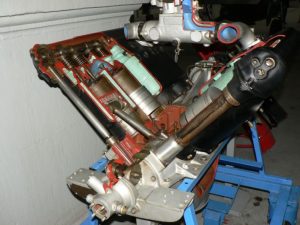
Cutaway of a Hispano 8A
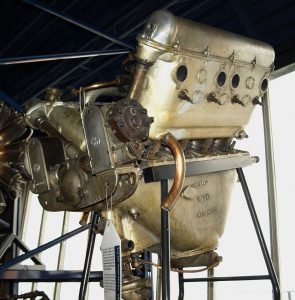
The Wolseley 6/80 Viper engine

SE5a WW1 Fighter plane

The Klimov VK-105 V12 engine
The original Hispano-Suiza 8A was rated at 140 hp (100 kW) and the later, larger displacement Hispano- 8F reached 330 hp (250 kW). The improved Hispano engine developed by Wolseley which was owned by the armaments company Vickers at the time, was built under licence in Birmingham and named the Wolseley Viper.
Wolseley increased the rev range of the engine to 2,500-750 rpm as well as significantly increasing the power output to 210 hp.
This speed meant that the tips of the propeller would go super sonic resulting in the shattering of the prop so, as Hispano had also done with the original improved 8A engine, the propeller was driven through a reduction gearbox.
The Viper engine was used in the Scout Experimental 5a (SE5a) biplane of WW1, the Hispano 8A engines were used in the Louis Béchereau designed French SPAD VII amongst others. The S.E.5 (Scout Experimental 5) was designed by Henry Folland, John Kenworthy and Major Frank Goodden of the Royal Aircraft Factory in Farnborough. It was built around the new 150 hp (112 kW) Hispano-Suiza 8 engine which, whilst providing excellent performance, was initially underdeveloped and unreliable.
Only 77 original S.E.5 aircraft were completed prior to production settling upon an improved model, designated as the S.E.5a, which initially differed from late production examples of the S.E.5 only in the type of engine installed – a geared 200 hp Hispano-Suiza 8B, often turning a large clockwise-rotation four-bladed propeller, replacing the 150 hp H.S. 8A model. In total 5,265 S.E.5s were constructed by six manufacturers: Austin Motors (1,650), Air Navigation and Engineering Company (560), Curtiss (1), Martinsyde (258), the Royal Aircraft Factory (200), Vickers (2,164) and Wolseley Motors Limited (431).
Another engine which bore striking similarities to the Hispano 8A was the 12Y which was produced by Hispano for the French Air Force in the pre-WWII period. This became the primary French 1,000 hp (750 kW) class engine and was used in a number of famous aircraft, including the Morane-Saulnier M.S.406 and Dewoitine D.520.
A further development, the 12Z, ended due to the German occupation of France. The 12Y was also produced under licence in the Soviet Union as the Klimov M-100. This design later spawned the highly successful Klimov VK-105 series that powered the Yakovlev and Lavochkin fighters as well as the Petlyakov Pe-2 bomber. Licensed production of the early models was also undertaken in Czechoslovakia.
It is the 12-cylinder version of the aero engines to which the VC engines bear the most resemblance (albeit a single 6-cylinder bank of the V12) and from which the VC’s valve train was copied.
The VC engines gained a reputation for burning out their exhaust valves after a relatively low mileage and there has always been much engineering debate as to why some engines were affected and others not.
Some engines, notably Series I’s, and often export vehicles to places such as Australia, clocked up very high mileages with never a hint of trouble, valve or otherwise, whilst others failed within 10,000 miles (16,00kms) or less and seemed to have the highest percentage in the “Home Market” as opposed to export vehicles.
It would seem fair to say that a combination of how the valves and guides operated, the materials they were made from, the use to which the vehicles were subjected, i.e. urban or town/city use, and the poor quality low octane petrol of the time (which was a major cause of overheating and detonation/pre-ignition and “running on” after switch off) were all contributing factors to the problem but not the major definitive cause. The favourite old wives’ tale was;
“The valves do not rotate therefore if carbon deposits or debris become trapped, hot spots develop and the valves burn out”.
Whilst it is true that the valves are prevented from rotating in their seats by a locking pin in the cylinder head which engages with a slot in the bottom spring retaining cup (intended to prevent the ratchet system of valve clearance adjustment from unwinding at high revs), subsequent removal of the pin and the placement of a roller bearing beneath the spring cup, thus allowing the valves to rotate freely has been found to make no difference and the valves still tended to burn out quite rapidly.
The major cause of the “burning problem” was the direct acting camshaft, the lobes of which put sideways thrust on the tops of the valve stems, causing the ovalling of the stems and the beryllium-copper valve guides, allowing the valves to rock from side to side when seating.
Beryllium-copper is a hard material with good heat transfer properties, but in combination with the material used for the exhaust valves, tended to “pick up” particles of the valve stems whilst in use, which then abraded against both guide and valve stem, ovalling their tops and bottoms, causing the rocking motion.
In the past, owners (in particular, the Metropolitan Police Force) had their valves “Stellited”, which entailed the valves having a layer of very hard material welded onto the operating faces. This did not cure the inherent problem but made the valves last much longer before needing replacement.
Sometimes, the valves would continue to rock and clatter until metal fatigue eventually set in and the valve heads would snap off at the weakest/narrowest point of the stem, dropping into the cylinders with disastrous results.
Any engines that may have suffered with valve problems will have been rectified by now but in any case, the club has commissioned the remanufacture of high quality stainless steel valves, both inlet and exhaust, and hard wearing phosphor bronze exhaust and cast iron inlet valve guides for both Series I and Series II engines.
The Club has never had a report of a newly produced part failing.
The earlier engines were designated as the Series I but towards the end of 1952, a redesigned cylinder head and cooling system with enlarged waterways was introduced, featuring longer stemmed valves which were designed to work at an improved angle.
This involved a well-known Royal Navy Engineer Commander Ladbrooke, working with the Metropolitan Police Force alongside Nuffield’s designers and engineers.
It featured a taller 10-port (4 exhaust ports, 6 inlets) design with a special “water rail” which transferred cooled water from the radiator, to the rear of the cylinder head via a twin impeller water pump. The cool water inlet on the S I engines was at the side of the block but tended to take the course of least resistance and did not circulate properly, causing the overheating of the rear two cylinders.
The cool water inlet on the S II engine was at the front of the cylinder head, the original inlet being used for a coolant drain tap.
The compression ratio was also reduced from 7.0:1 to 6.5:1 to prevent detonation and “running on” after switch-off. The rear axle ratio was lowered from 4.1:1 to 4.55:1 to compensate for the loss of power and restore acceleration at the expense of top speed.
This later engine became known as the Series II commencing from Engine Number 20301 (and also a limited number of engines commencing No. 1001/2). The S II engine block had an extra sump attachment bolt close to the oil filter housing.
Any engine (regardless of manufacturer) that is allowed to overheat will also create additional cylinder head problems, usually resulting in cracking of the head. Had the manufacturer fitted a temperature gauge as standard equipment, early indications that the engine was getting too hot would have been spotted by the driver and many engines may have survived longer.
It is unfortunate that the engine was not further developed but the merger in 1952 of The Nuffield Organisation with Austin, to become BMC, meant that the ohv ‘A’ ‘B’ and ‘C’ series engines became available and plans for the “V” family of engines were shelved.

Hispano 8A valve gear
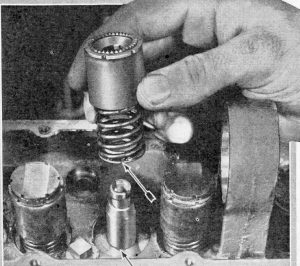
Locking pin and slot – arrowed
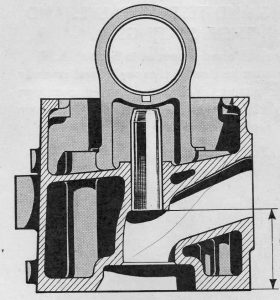
Cross section of S I cyl head

Adjustment of valve clearances
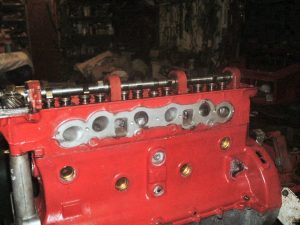
Series I engine with 8-port head

Series II 10-port head with water transfer rail below
All the 1948 – ‘54 Nuffield engines, utilised the same bore and stroke, pistons rings, con rods and bearing shells thus the pistons (for example) from a VC22W 6/80 engine will fit a VS15M Oxford MO side valve engine, and vice versa.
When BMC was formed in 1952, engine production became concentrated on the ohv engines but the Wolseley 6/80, MS6 and Oxford MO continued in production until the stock of parts began to dwindle. The remaining stock for the Oxford MO was sold to Hindustan in Calcutta, India and a lot of the remaining 6/80 and MS6 stock went to the Zetland plant in Sydney Australia.
There were instances towards the end of the Australian production run, of Wolseley 6/80’s being fitted with the later 2.6 litre ohv ‘C’ Series engines, to use up the final few body shells.
This has been much disputed but it is known to have been experimented with in 1952 by the UK factory which fitted the ‘C’ Series engine into an MS6 and also an Austin Hereford.
Most owners nowadays fit a thermostatically switched electric cooling fan with manual override, and a temperature gauge to keep an eye on things under the bonnet. Ensuring the cooling system is clear and the radiator not clogged up is essential.
Rpm is limited to 4,600, not by valve or cylinder head design but by the lightweight valve springs which allow the valves to bounce when seating, thus limiting the efficiency. The fitting of stiffer valve springs helps eliminate this and, as experimented with by the author, allowed the engine (in the case of his own MS6 engine) to rev to 6,000rpm. The extra stiffness preventing the ratchet adjusters from unwinding at speed.
Other modifications to the VC22 engine have included the use of ‘O’ Series engine pistons, which have a lower piston crown height, and “stroking” the crankshaft to 4” by welding material onto the outer surfaces of the crank pins and machining to size, increasing capacity to some 2.7 litres. Jaguar XK cylinder liners and custom pistons have also been used, increasing capacity to 2.9 – 3.0 litres and with other modifications, bhp increased to 150.
The VC15W which was used in the Wolseley 4/50 was a 4-cylinder version of the 6-cylinder unit. It had a cubic capacity of 1476.53cc (90.1 cu in) and a power output of 49bhp@4,600rpm. No crank or camshaft damper was necessary.
The VC15W suffered the same inherent valve burning and overheating problems as the VC22 unit and just before the model was discontinued in 1952, the final few cars were fitted with the 4-cylinder version of the S II cylinder head.
Due to the rarity of these engines, a popular replacement is the BMC ‘B’ Series, utilising a Hindustan Ambassador bell housing in order to retain the original column change gearbox. The club can help with advice as to how this is done.
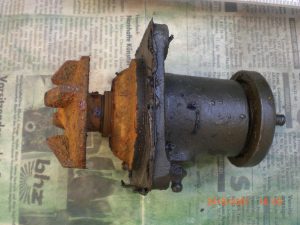
Series I water pump
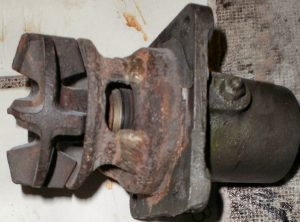
Series II water pump with twin impellers