THE MORRIS OXFORD SERIES MO

The Morris Oxford Series MO was introduced at the 1948 Earls Court London Motor Show and was a member of the same family as the Morris Six and the Minor, all being the design of Alec Issigonis (later Sir Alec). The engine was a newly designed four-cylinder side-valve unit of 1476.53cc, which produced 41bhp @ 4,200 rpm, produced at the Morris Engines Branch in Coventry. Of the 154,932 MO’s made, 1,282 saloons survive with full information known to the club.
At the first post-war British Motor Show at Earls Court in October 1948, Morris presented a brand new range of family cars, the Morris Minor MM, Oxford MO and Morris Six Series MS (MS6), which replaced the pre-war designs.
The MM, to which the MO is the “Big Brother” had been placed in the hands of a young Alec Issigonis (later ‘Sir Alec’) by Nuffield Organisation Vice-Chairman Miles Thomas, who had been quick to perceive an exceptional talent.
The cars which emerged from Issigonis’s sketch-pad and from engineering drawings prepared by his two right-hand men Jack Daniels and Reg Job, were by the standards of the 1940’s, unconventional.
Gone were separate running boards and wings, replaced by a highly modern unitary body shell which dispensed with a chassis frame and which displayed advanced Transatlantic styling features never seen before on British cars.
Early MO’s are identified by their pointed bonnet ends, until chassis N°’s rhd-19954, lhd-20981 (approx. mid to late August 1949). The boot lid had a pressed in number plate recess, incorporating a “D” shaped light at the right-hand end which was discontinued from Chassis N°14831 (rhd) circa April/May 1949. (1st vehicle off assembly line on 1st April ‘49 was N°12357, 1st July N°18246)
Some export cars to Australia, notably Western Australia also had a separate rear-lights switch mounted on the driver’s side rear wing above the rear lamp, for which it was necessary to exit the car to turn them on or off. This was to prevent night time “hit and run” drivers from just switching off the lights (thus hiding the number plate) and driving off without stopping/being identified.
Separate side lights were soon placed beneath the headlamps.
The rear window roller blind gave way to a new style interior mirror with an “anti-dazzle” flip-dip feature which helped eliminate dazzle from following vehicle headlights.
The most noticeable change affected the radiator grille. Up until October 1952 it was a one-piece unit in chromed Mazak (a zinc based alloy with traces of magnesium copper and aluminium) which finished at chassis N°117565. It changed to a two-piece in stainless steel from N°117566. All the modifications seemed to follow their own timetable, often leading to much confusion.
An extensive list of the changes can be found in Steve McNicol’s book “Morris Oxford MO” published by Railmac in 1991.
Of the 154,932 MO’s made, 1,282 saloons survive with full information, and are known to the club.
If we include those for which the club only has partial information, the number is 1,341.
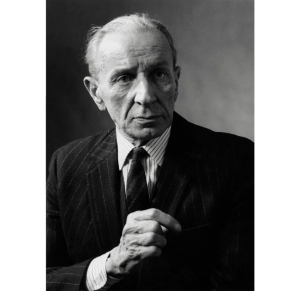
Sir Alec Issigonis

Jack Daniels

Early MO with pointed bonnet ends, no separate sidelights
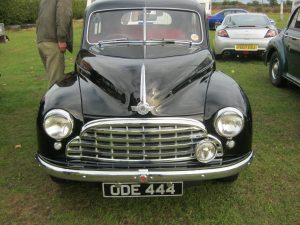
Early MO with later bonnet and separate sidelights.
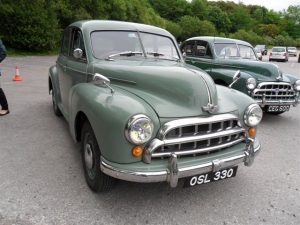
Later style grille
At around the same time that the grille was changed, some changes occurred in the interior as well.
The black/dark brown crinkle finish of the centre instrument panel was dropped in favour of a gold painted panel which matched the glove box covers.
The instruments which originally had plain magnolia dials and fasciae, now sported black internal bezel rings.
The very early interiors had beige leather bench seats with brown piping, changed to brown, green or red leather in a plainer style.
The engine was a newly designed four-cylinder side-valve unit of 1476.53cc (90.1 cu. in.) which produced 41bhp @ 4,200 rpm with a compression ratio of 6.5-6.6:1, produced at the Morris Engines Branch in Coventry. The crankshaft was machined from a drop forged solid steel billet and shared the same crank pin and main bearings, and pistons, as the Wolseley 6/80, 4/50 and MS6 engines.
Engine fuelling was by a single S.U. HS2 1 ¼” carburettor fed by an S.U. L-type electric pump mounted on the firewall.
The clutch was a 7 ¼” Borg & Beck A.6-G dry plate with composite facing, transferring drive to a four speed gearbox, the gear lever being mounted on the steering column. Final drive by prop-shaft to a semi-floating hypoid axle. Steering was by rack and pinion.
The all hydraulic braking system used Lockheed 8 in. diameter drums, front-twin leading shoes, rear-one leading and one trailing.
The front suspension was independent with torsion bars; the rear axle was located by semi-elliptic leaf springs.
Early cars were fitted with Armstrong lever type dampers all round which were soon changed for telescopic types at the rear.
Issigonis had planned to use the Jowett flat-four boxer engines for both the Minor and Oxford but company politics short-circuited the idea, the Minor ending up with the 918cc Morris Eight engine and the Oxford with the new side-valve engine mentioned above. It wasn’t intended to be earth-shaking or a tyre burner, merely steady and reliable and it is amazing how many have survived and are still in use today. Progress in the MO is best described as “stately” although the car can reach 69mph (in favourable conditions) and will cruise happily at 55-60mph for long periods.
If there was a weakness to be found, it was in the fibre camshaft timing wheel, employed for its quietness as opposed to a timing chain, and the VS15M (‘V’ for V engine family, ‘S’ for “side-valve” 15 for 1.5 litre, ‘M’ for Morris) is indeed a very quiet engine.
The cause of timing gear failure was usually lack of lubrication, the car grinding to a halt when the gear teeth stripped off.
Fortunately, the club produces replacement timing gears in hard wearing Tufnol for any owners unfortunate to experience this. There is also a matched steel and aluminium set available, which is virtually indestructible, produced by a company in Australia.
In the 1950’s a tuning kit was available for the MO engine, made by Derrington, comprising of an internally-copper-plated cylinder head with a higher compression ratio, a tuned large bore exhaust system, twin SU HS2 1 ¼” carburettors, and twin valve springs to eliminate valve bounce, which increased the rev range and bhp, making the car more tractable and able to reach 78mph!
This kit can still be found on odd occasions and is much sought after.
When the Nuffield Organisation merged with Austin in 1952 to become BMC, the Austin designed ‘A’ ‘B’ & ‘C’ series engines became available. The MO continued in production until early1954 but most of the excess stock was sold to Hindustan in Calcutta, India, where the MO was built under licence and badged as the Hindustan 14.
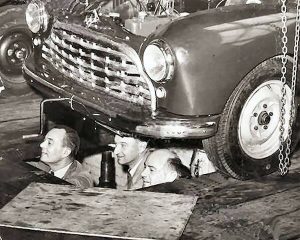
It was known that the UK factory experimented with the ‘B’ series engines in the Oxford MO as can be seen in the photo (below left, Alec Issigonis is in the middle, designer Jack Daniels – apparently – is to the left) where one can just see the rocker cover of a ‘B’ series engine beneath the raised bonnet. If it had been a side-valve unit, which is much shorter, it would not have been visible.
The BMC ‘B’ series engine is a popular replacement for the side-valve engine, which is becoming rare, and allows the car to keep up with modern traffic conditions, i.e. stress free motorway driving.
The conversion is done using a Hindustan bellhousing (used in the Landmaster and early Ambassador range of vehicles) in order to retain the original column-change gearbox. The ‘B’ series engine with floor-change gearbox can be fitted but requires some modifications to the gearbox cover plate. Some other modifications/parts may be needed depending on the model of ‘B’ series engine.
Although there is no longer a Hindustan importer in the UK, the club has contacts in India who can source the necessary part/s (second hand) and arrange shipping, at very reasonable prices.
The club can also help with advice on how to carry out this conversion, which is not difficult to do.
All in all, the Morris Oxford MO is a very comfortable and popular car, pleasant to drive and easy to live with.

Engine bay of a 1949 MO. Post ‘52 cars had the battery mounted on the driver’s side, low down in the engine bay

Early bootlids and rear lights
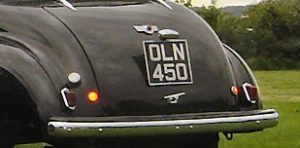
Later bootlids and rear lights

Early dashboards and instruments.
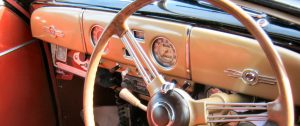
Later dashboards and instruments.